Reesinc.com

Frequently Asked Questions (FAQ)

A LEADER IN THE DESIGN OF CONTROL SWITCHES SINCE 1929

[helpie_faq group_id='10'/]
Rees Inc. FAQ Gallery
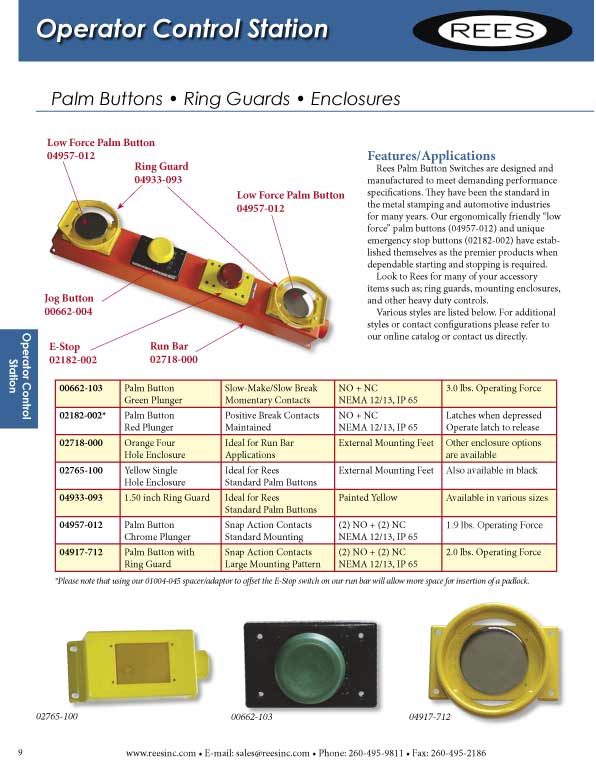
A palm button is a large-diameter push button operator specifically designed to be actuated by the palm of the hand rather than a fingertip. Rees palm buttons feature oversized actuator surfaces (typically 2-3 inches in diameter) that require deliberate palm pressure to activate, making them ideal for two-hand control safety applications on stamping presses, forming equipment, and other machinery where keeping operators' hands safely positioned is critical. Unlike standard push buttons that can be accidentally triggered by bumping, palm buttons require intentional engagement.
A ring guard is a protective barrier that surrounds a palm button operator, preventing accidental actuation from bumping, leaning, or dropping objects onto the control. Rees ring guards require operators to deliberately reach inside the guard to engage the palm button, significantly reducing the risk of unintended machine cycles. Ring guards are especially important in high-cycle production environments like stamping operations where accidental actuation could result in serious injury or equipment damage.
Rees manufactures operator control station enclosures in multiple NEMA ratings to suit various industrial environments. Options include NEMA 1 (general purpose indoor), NEMA 4 (watertight for washdown areas), NEMA 4X (watertight and corrosion-resistant for food processing), NEMA 12 (dust-tight and drip-tight for manufacturing), and NEMA 13 (oil-tight for machining operations). Enclosures are available in cast aluminum, steel, stainless steel, and fiberglass-reinforced polyester construction.
Yes, Rees specializes in custom operator control station configurations. We can build stations with multiple palm buttons, selector switches, pilot lights, emergency stops, and other operators in a single enclosure tailored to your specific machine control requirements. Custom legend plates, wire colors, and connector options are available. Our engineering team works directly with customers to design control stations that meet exact specifications for both functionality and safety compliance.
Two-hand control is a safety system requiring simultaneous actuation of two separate palm buttons to initiate machine motion, ensuring the operator's hands are safely positioned away from the point of operation. Rees two-hand control stations meet OSHA 29 CFR 1910.217 requirements for mechanical power presses and include anti-tiedown circuitry that requires release of both buttons before a subsequent cycle can be initiated. This prevents operators from defeating the safety system by blocking one button.
Yes, Rees palm buttons feature ergonomic designs that reduce operator fatigue during repetitive operations. The contoured actuator surface provides comfortable palm engagement, while the actuation force is calibrated to prevent accidental triggering while remaining easy to engage intentionally. Our palm button stations can be mounted at adjustable heights and angles to optimize operator positioning and reduce strain during extended production runs.
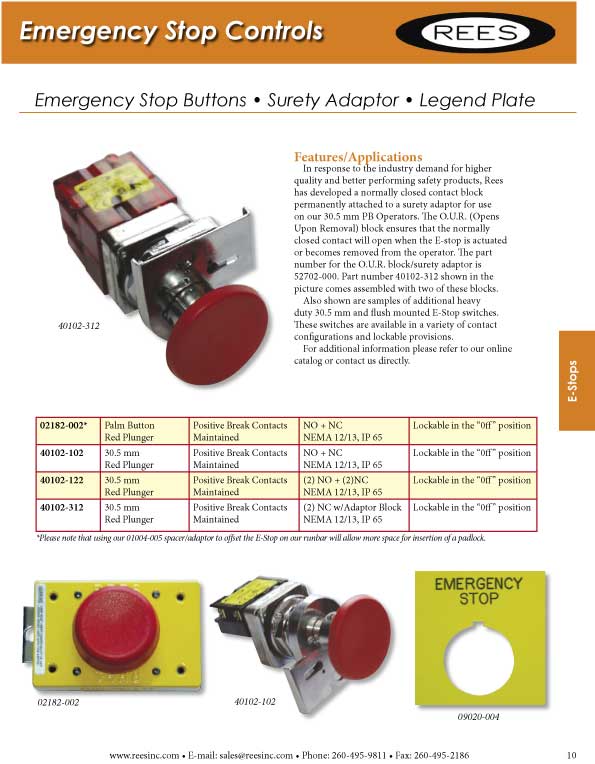
Rees palm buttons are available in multiple colors to meet safety standards and operator preference. Standard colors include black (general actuation), green (start/run functions), and yellow (special functions). Emergency stop palm buttons feature the required red operator with yellow housing per OSHA and ANSI standards. Custom colors can be specified for OEM applications or to match existing plant color-coding systems.
Rees palm buttons are designed for exceptional durability in demanding industrial environments. Our heavy-duty construction and quality materials deliver a mechanical life exceeding 1,000,000 operations under normal use conditions. Many Rees palm button installations remain in continuous service for 20-30+ years. The robust design withstands the vibration, impact, oil exposure, and temperature extremes encountered in stamping plants, foundries, and heavy manufacturing facilities.
A contact block is the electrical switching element that mounts behind the operator (button, selector, etc.) and contains the actual electrical contacts that open or close the circuit. When an emergency stop button is pressed, the mechanical linkage actuates the contact block to interrupt power to the machine. Rees contact blocks feature snap-action mechanisms for positive contact operation and are available in normally open (NO), normally closed (NC), and combination configurations for safety circuit redundancy.
Positive-opening contacts (also called direct-opening or positive-break contacts) are mechanically linked to the actuator in a way that forces the contacts apart even if they have become welded together. This is critical for emergency stop circuits because it ensures the E-stop will function even after a contact welding failure. Rees emergency stop contact blocks meet IEC 60947-5-1 requirements for direct-opening action, providing the reliability demanded by safety-rated control circuits.
Rees emergency stop operators accommodate multiple stacked contact blocks for complex safety circuit requirements. Standard configurations allow up to 6 contact blocks per operator, providing up to 12 contact poles (any combination of NO and NC). This stacking capability allows a single E-stop button to control multiple safety circuits simultaneously, such as stopping machine motion while also signaling a safety PLC and activating an alarm indicator.
Rees offers contact blocks in multiple ratings to suit different application requirements. Our Heavy Duty A600/N150 rated contacts handle motor control and high-current applications, while standard contacts are rated for control circuit loads. All Rees contact blocks are UL Listed and CSA Certified for industrial control applications. Contact specifications include voltage ratings up to 600VAC, current ratings appropriate for both resistive and inductive loads, and breaking capacity suitable for emergency stopping applications.
Yes, Rees contact blocks feature gold-plated bifurcated contacts for reliable low-level signal switching. Gold plating prevents oxidation and ensures consistent contact resistance over millions of operations, which is essential for PLC input signals and safety relay circuits operating at low voltage and current levels. The bifurcated (split) contact design provides redundant contact points, further enhancing reliability in safety-critical applications.
Rees contact blocks are engineered for exceptional longevity with a mechanical life rating exceeding 1,000,000 operations. The electrical life varies based on load conditions but exceeds 100,000 operations at rated load. This durability makes Rees contact blocks ideal for high-cycle applications where frequent emergency stop testing and production use demand reliable long-term performance. Our contacts maintain consistent operation throughout their service life without degradation.
Yes, Rees maintains backward compatibility and continues to supply contact blocks for emergency stop installations dating back decades. Our current contact blocks are designed to retrofit older Rees operators, allowing facilities to refresh the electrical components while retaining existing enclosures and operators. This availability of replacement parts is one reason many plants standardize on Rees—they know they can maintain their safety equipment for the long term.
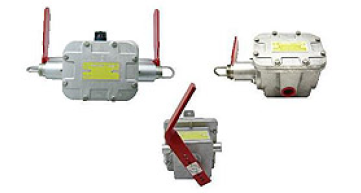
An explosion proof cable operated switch (also called a rope pull switch) is designed to contain any internal explosion that might occur if flammable gases or combustible dusts enter the enclosure and are ignited by electrical arcing. The heavy-duty enclosure prevents flames from escaping and igniting the surrounding hazardous atmosphere. Explosion proof cable switches are required in classified hazardous locations as defined by NEC Article 500, including oil refineries, chemical plants, grain elevators, and anywhere flammable gases, vapors, or combustible dusts may be present near conveyor systems.
Rees explosion proof cable operated switches are UL and CSA listed for Class I, Division 1, Groups C and D (flammable gases and vapors including acetone, ammonia, gasoline, and natural gas) and Class II, Division 1, Groups E, F, and G (combustible dusts including metal dust, coal dust, flour, and grain). These certifications cover the most common hazardous location classifications encountered in industrial facilities requiring explosion proof conveyor safety controls.
NEMA 7 enclosures are designed for indoor hazardous locations with flammable gases and vapors (Class I). NEMA 9 enclosures are designed for indoor hazardous locations with combustible dusts (Class II). Rees explosion proof cable operated switches are available in both NEMA 7 and NEMA 9 configurations, as well as combination ratings for facilities where both gas and dust hazards may exist. The enclosure design differs to address the specific containment requirements of each hazard type.
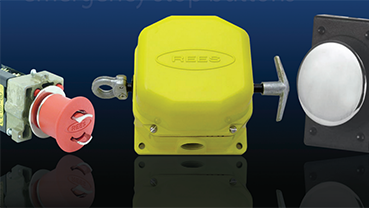
Rees manufactures explosion proof cable pull switches (rope pull switches) for emergency stop protection along conveyors and equipment in hazardous locations. These switches combine the continuous emergency stop coverage of cable-operated switches with explosion proof enclosures suitable for Class I and Class II Division 1 locations. Applications include conveyor systems in grain handling, mining, chemical processing, and petroleum facilities where workers need emergency stop access along the entire conveyor run.
Rees explosion proof cable operated switches are used across numerous industries where hazardous atmospheres exist near conveyor systems, including oil and gas production and refining, chemical manufacturing and processing, pharmaceutical production, grain handling and flour milling, coal mining and processing, paint and coating manufacturing, ethanol and biofuel production, and wastewater treatment facilities. Any location classified as a hazardous area under NEC Article 500 with conveyor equipment may require explosion proof cable switches.
Hazardous location classification is typically determined by a qualified electrical engineer or safety professional following NEC Article 500 guidelines. Key factors include the types of flammable materials present, their ignition characteristics, the likelihood of hazardous concentrations occurring during normal or abnormal conditions, and the area's ventilation. Once areas are classified (Class/Division/Group), appropriate explosion proof equipment ratings can be specified. Rees technical support can help identify the correct cable switch products once classification is established.
Rees explosion proof cable operated switches are available with multiple features including slack-cable detection, broken-cable detection, LED status indicators, and manual reset mechanisms. The heavy-duty cast aluminum enclosures withstand harsh industrial environments while maintaining their explosion-proof integrity. Both single-direction and bi-directional pull configurations are available to suit different conveyor safety requirements.
For explosion proof cable switches used in the United States, look for UL listing for the specific Class, Division, and Groups present in your facility. CSA certification is required for Canadian installations. The certification label should clearly identify the hazardous location ratings (e.g., "Class I, Div. 1, Groups C, D"). Rees explosion proof cable operated switches carry both UL and CSA certifications and are clearly labeled with all applicable hazardous location ratings.
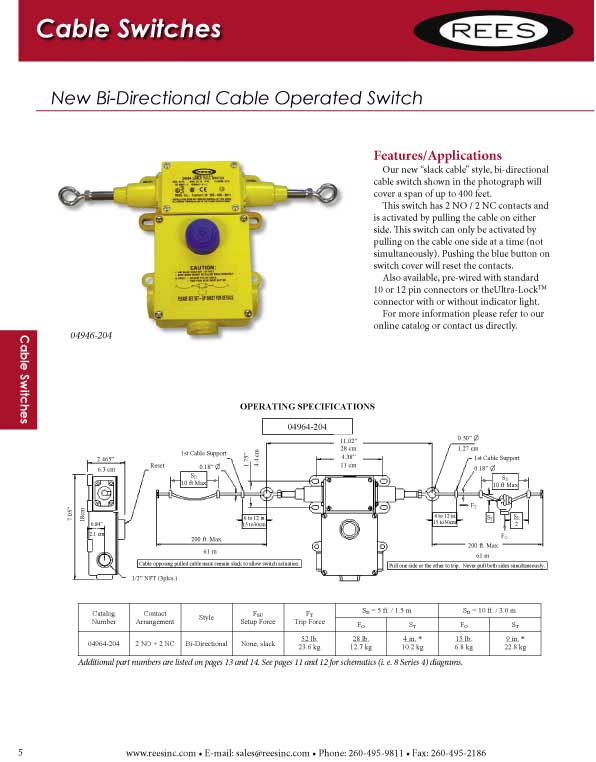
A bi-directional cable operated switch (also called a bi-directional rope pull switch) is an emergency stop device that responds to cable pulls from either direction along a conveyor or machine. Unlike single-direction switches that only detect pulls toward one side, bi-directional switches trigger an emergency stop whether the cable is pulled left or right. This provides comprehensive protection along conveyor systems where workers may need to activate the emergency stop from any position along the line.
Rees bi-directional cable switches can be installed at intervals up to 400 feet apart when using standard wire rope cable with appropriate tensioning. For longer conveyor runs, multiple switches can be installed.
Yes, Rees bi-directional cable operated switches are available in broken-cable detection configurations. These switches monitor cable tension continuously and trigger an emergency stop if the cable breaks, is cut, or loses tension beyond the set threshold. Broken-cable detection provides an additional layer of safety beyond simple pull detection, ensuring that cable damage does not leave workers unprotected. Both slack-cable and broken-cable detection styles are available.
Bi-directional cable switches offer several advantages over single-direction designs. They eliminate the need to determine cable pull direction during installation, reducing installation errors. Workers can pull the cable in whichever direction is most natural from their position, improving response time in emergencies. Bi-directional switches also reduce the number of switch stations required for some installations, since each switch provides full protection in both directions.
Rees bi-directional cable operated switches are available in NEMA 4X (watertight indoor), NEMA 12 (dust-tight and drip-tight), and NEMA 13 (oil-tight) enclosure ratings for various industrial environments. NEMA 4 is recommended for outdoor conveyors, washdown areas, and mining applications. NEMA 12 suits general manufacturing environments. NEMA 13 is ideal for applications with exposure to cutting oils, coolants, and lubricants.
Rees bi-directional cable switches feature manual reset mechanisms requiring deliberate operator action to restore normal operation after an emergency stop. Reset is typically accomplished by returning the cable to its normal tensioned position and manually actuating the reset mechanism on the switch. This positive reset requirement ensures that equipment cannot be restarted until a worker has verified the area is safe and intentionally reset the emergency stop device.
Yes, Rees offers bi-directional cable switches with optional LED status indicators that provide visual confirmation of switch status. Indicators show whether the switch is in the normal (run) position or has been tripped. Some models include separate indicators for left and right pull detection, allowing maintenance personnel to quickly identify which direction the emergency stop was activated from. LED indicators are especially valuable in long conveyor installations where multiple switches may be present.
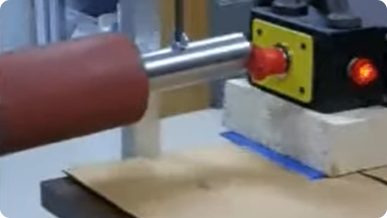
The Rees 22.5mm operator impact test demonstrates the exceptional durability of our 22.5mm push button operators under severe impact conditions. In this test, Rees operators are subjected to repeated impacts that far exceed normal operating conditions, simulating years of abuse in demanding industrial environments. The test showcases why Rees operators outlast competitors and continue to function reliably even after impacts that would destroy lesser products.
Industrial push button operators are frequently subjected to accidental impacts from tools, parts, forklifts, and other equipment in manufacturing environments. Operators that crack, break, or malfunction after impact create safety hazards and production downtime. Rees 22.5mm operators are engineered to withstand severe impacts while maintaining full functionality, ensuring reliable control even in the most demanding facilities where abuse is common.
Rees 22.5mm operators feature high-impact thermoplastic and reinforced polymer construction engineered specifically for industrial abuse resistance. The materials are selected for their combination of strength, toughness, and resistance to environmental factors including UV exposure, chemicals, and temperature extremes. Our heavy-duty construction significantly exceeds the requirements of standard commercial-grade operators found on imported equipment.
In comparative impact testing, Rees 22.5mm operators consistently outperform imported competitors by a wide margin. Many imported operators crack or shatter on the first significant impact, while Rees operators continue to function normally after dozens of severe impacts. This durability advantage translates directly to lower maintenance costs, reduced downtime, and improved safety for facilities that specify Rees controls.
No, Rees operators maintain full electrical functionality even after severe impacts. Our internal mechanism design isolates the contact blocks from impact forces transmitted through the operator. The positive mechanical linkage ensures reliable contact actuation regardless of any minor deformation that might occur in the operator housing. This means you can depend on Rees operators to perform their control function even after accidental abuse.
The Rees 22.5mm operator impact test video is available on the Rees, Inc. YouTube channel and on our FAQ & Gallery page at reesinc.com/faq-gallery. The video demonstrates the remarkable durability of Rees operators compared to competitor products and shows exactly why so many facilities standardize on Rees controls for demanding industrial applications.
Rees manufactures a complete line of 22.5mm operators including push buttons (flush, extended, and mushroom-head styles), selector switches (2-position and 3-position, maintained and spring-return), emergency stops (push-pull and key-release reset), pilot lights (LED and incandescent), and combination units. All share the same robust construction demonstrated in our impact testing and are designed for heavy-duty industrial applications.
Yes, Rees 22.5mm operators fit standard 22.5mm (7/8 inch) panel cutouts, making them drop-in replacements for existing installations. This compatibility allows facilities to upgrade to more durable Rees operators without panel modifications. Our 22.5mm product line is designed for easy integration with existing control panels, operator stations, and HMI interfaces using industry-standard mounting dimensions.
FedEx relies on Rees cable pull switches and emergency stop controls to protect workers along the miles of conveyor systems in their distribution hubs. The high-speed package sorting operations at FedEx facilities require safety switches that can withstand continuous operation, frequent cleaning, and the demanding 24/7 schedules of major shipping hubs. Rees switches provide the reliability and durability FedEx requires to maintain both worker safety and operational efficiency.
Before adopting Rees switches, FedEx experienced issues with competitor cable pull switches that failed prematurely, requiring frequent replacement and causing unnecessary maintenance downtime. Some switches provided inconsistent operation or failed to trip reliably when activated. The cost of switch failures—both in replacement parts and lost productivity—led FedEx to seek a more reliable solution that could handle the demanding conditions of their high-volume distribution operations.
FedEx uses Rees cable pull switches (rope pull emergency stops) along their conveyor lines, providing continuous emergency stop protection throughout their sorting facilities. They also use Rees push button stations at operator positions for conveyor motor control and emergency stopping. The combination of cable pull switches for full-length conveyor protection and push button stations at operator interfaces provides comprehensive safety coverage throughout their facilities.
Rees switches have improved safety at FedEx facilities by providing more reliable emergency stopping capability along conveyor systems. Workers can trust that pulling the cable will immediately stop conveyor motion, giving them confidence to work near moving equipment. The consistent operation of Rees switches means the emergency stop system works every time it's needed, whether for actual emergencies or routine stoppage for clearing jams and performing maintenance.
FedEx has reduced maintenance costs significantly by standardizing on Rees switches. The exceptional durability of Rees products means fewer switch replacements, less unplanned downtime, and reduced maintenance labor. While Rees switches may have a higher initial cost than some competitors, the total cost of ownership is substantially lower when factoring in longevity, reliability, and reduced maintenance requirements over the multi-decade service life typical of Rees products.
Yes, after experiencing the reliability of Rees products in initial installations, FedEx has expanded their use of Rees switches to additional facilities and applications. The positive experience with cable pull switches led to adoption of Rees push button stations and other control products. This expansion reflects the confidence FedEx has developed in Rees quality and the value of standardizing on proven reliable equipment across their distribution network.
The complete FedEx case study is available for download on the Rees, Inc. website at reesinc.com/faq-gallery. The case study provides detailed information about FedEx's experience with Rees products, including specific challenges addressed, products implemented, and results achieved. Contact Rees sales for additional information about how our products can address similar challenges in your distribution or material handling operations.
Ford Motor Company uses Rees emergency stop switches, palm buttons, and cable pull switches throughout their automotive assembly and manufacturing facilities. Rees products protect workers on assembly lines, in stamping operations, at robotic welding cells, and along conveyor systems throughout Ford's North American manufacturing network. The demanding requirements of automotive production—high cycle counts, harsh environments, and critical safety needs—make Rees products an ideal choice for Ford's operations.
Ford standardized on Rees safety controls due to their exceptional reliability, durability, and long service life. Automotive manufacturing demands equipment that can operate continuously through multiple shifts without failure. Rees switches have proven themselves capable of withstanding the oil, coolant, metal chips, and heavy use encountered in automotive plants while maintaining reliable operation for decades. Ford's standardization on Rees reflects the value they place on worker safety and operational uptime.
Ford assembly plants typically utilize Rees 30.5mm emergency stop push buttons at operator stations and machine access points, palm button two-hand controls on stamping presses and forming equipment, cable pull switches along conveyor systems for continuous emergency stop protection, and heavy-duty push button stations for motor control and machine operation. The specific product mix varies by application, but Rees products are found throughout Ford's manufacturing operations.
Rees palm buttons and two-hand controls have performed exceptionally well in Ford's demanding stamping operations. The high cycle counts, oil exposure, and metal chip environment of stamping presses require robust controls that won't fail under pressure. Rees heavy-duty construction and million-cycle contact life ensure reliable operation throughout the production life of Ford's stamping equipment. Many original Rees installations continue to operate after 30+ years of continuous service.
Yes, Ford uses Rees safety switches in their electric vehicle manufacturing facilities, including the production of the F-150 Lightning and Mustang Mach-E. EV manufacturing presents unique safety requirements, including areas where explosion proof cable switches may be required for battery handling and charging operations. Rees offers both standard and explosion proof cable operated switches suitable for the full range of EV manufacturing applications.
Rees supports Ford's lean manufacturing initiatives by providing reliable products that minimize unplanned downtime. The exceptional durability of Rees switches means fewer failures, less maintenance, and more predictable operations. By reducing variability and eliminating equipment-related production disruptions, Rees products contribute to the smooth flow of Ford's manufacturing operations. The long service life of Rees switches also aligns with lean principles of reducing waste and maximizing value.
The Ford Motor Company case study is available for download on the Rees, Inc. website at reesinc.com/faq-gallery. The case study details Ford's experience with Rees products across their manufacturing operations and highlights the specific benefits they've achieved. Contact Rees sales to discuss how our products can provide similar benefits for your automotive manufacturing or other industrial applications.
[helpie_faq group_id='10'/]